 Add to Chrome
 Add to Firefox
 Add to Edge
Conformal Reliability: A New Evaluation Metric for Conditional Generation
May 29, 2026
Conditional generative models have recently achieved remarkable success in various applications. However, a suitable metric for evaluating the reliability of these models, which takes into account their inherent uncertainty, is still lacking. Existing metrics, which typically assess a single output, may fail to capture the variability or potential risks in generation. In this paper, we propose a novel evaluation metric called reliability score based on conformal prediction, which measures the worst-case performance within the prediction set at a pre-specified confidence level. However, computing this score is challenging due to the high-dimensional nature of the output space and the nonconvexity of both the metric function and the prediction set. To efficiently compute this score, we introduce Conformal ReLiability (CReL), a framework that can (i) construct the prediction set with desired coverage; and (ii) accurately optimize the reliability score within the constructed prediction set. We provide theoretical results on coverage and demonstrate empirically that our method produces more informative prediction sets than existing approaches. Experiments on synthetic data and the image-to-text and text-to-image tasks further demonstrate the interpretability of our new metric, and the validity and effectiveness of our computational framework. Source code can be found at https://ggc29.github.io/CReL/.

Sample-Efficient Diffusion-based Reinforcement Learning with Critic Guidance
May 28, 2026Recent advances in reinforcement learning (RL) have achieved great successes by leveraging the multimodality and exploration capability of diffusion policies. Among these approaches, one representative branch focuses on the sampling-based policy optimization. This design enables better exploration capability of the diffusion model, particularly at the beginning of training, but suffer from low exploitation in Q-value information, resulting in a slow policy convergence. Another branch pays attention to gradient-based policy optimization, which sufficiently exploits the gradient of the Q function yet tends to collapse into a unimodal policy with low diversity. To address this issue, we propose CGPO, \textbf{C}ritic-\textbf{G}uided diffusion \textbf{P}olicy \textbf{O}ptimization, which effectively balances exploration and exploitation with the training-free guidance technique integrated into the denoising process of diffusion policy. Concretely, CGPO steers action generation toward high-value regions defined by the critic network and uses the guided actions as regression objectives. In this manner, CGPO reduces the time required to obtain high-quality actions and improves final performance with better balance between the exploration-exploitation tradeoff. We validate the effectiveness of CGPO on 5 MuJoCo locomotion tasks, and CGPO achieves state-of-the-art performance compared with existing diffusion-based RL methods. Notably, CGPO is the first success to incorporate diffusion policy into real-world RL, with its superior performance on Franka robot arm grasping tasks. Our official page is released at https://dingsht.tech/cgpo-webpage.
DiscoForcing: A Unified Framework for Real-Time Audio-Driven Character Control with Diffusion Forcing
May 27, 2026We study real-time audio-responsive character control as a deployment-faithful problem: strictly causal, bounded-latency streaming that must generate coherent full-body motion at interactive frame rates while the audio condition can change abruptly, including tempo shifts, drops, or user edits. Prior music-to-motion systems are largely optimized for offline generation with global context, and degrade in streaming rollouts where conditioning history becomes stale or unreliable. We introduce DiscoForcing, a streaming audio-driven diffusion framework that combines a causal music encoder that captures rhythmic structure and phase dynamics with a diffusion-forcing sequence model trained under heterogeneous noise levels across the temporal horizon. Building on this, we design a hybrid temporal schedule and a history-guided streaming sampler to explicitly trade off responsiveness against long-horizon consistency under non-stationary audio. Implemented in an end-to-end real-time interactive system with online avatar playback and humanoid deployment workflows, DiscoForcing delivers more stable long-horizon rollouts and sharper audio-motion alignment than prior baselines under matched causality and latency constraints while maintaining real-time throughput.
Stochastic MeanFlow Policies: One-Step Generative Control with Entropic Mirror Descent
May 21, 2026Online off-policy reinforcement learning (RL) is shaped by two coupled choices: the policy class and the update rule. Gaussian policies are fast and have tractable entropy, but struggle with multimodal action distributions. Generative policies are more expressive, but often require iterative sampling or lack tractable entropy estimates. On the optimisation side, SAC-style soft policy improvement and mirror descent (MD) can be viewed as minimising different KL divergences: the former moves the policy towards a value-induced Boltzmann distribution, while the latter regularises each update against the previous policy. Combining entropy regularisation with an MD constraint is therefore attractive, as it supports exploration while stabilising policy improvement; however, the resulting target can be multimodal and is poorly matched by unimodal Gaussian policies. We propose Stochastic MeanFlow Policies (SMFP), a one-step generative policy class that maps Gaussian noise to actions through a MeanFlow transformation. This stochastic reparameterisation yields a tractable entropy surrogate and allows MeanFlow policies to be trained within off-policy mirror descent under a unified objective for exploratory yet stable improvement. Across seven MuJoCo benchmarks, SMFP improves over Gaussian and generative baselines while retaining single-step inference efficiency.
UniHM: Unified Dexterous Hand Manipulation with Vision Language Model
Feb 28, 2026Planning physically feasible dexterous hand manipulation is a central challenge in robotic manipulation and Embodied AI. Prior work typically relies on object-centric cues or precise hand-object interaction sequences, foregoing the rich, compositional guidance of open-vocabulary instruction. We introduce UniHM, the first framework for unified dexterous hand manipulation guided by free-form language commands. We propose a Unified Hand-Dexterous Tokenizer that maps heterogeneous dexterous-hand morphologies into a single shared codebook, improving cross-dexterous hand generalization and scalability to new morphologies. Our vision language action model is trained solely on human-object interaction data, eliminating the need for massive real-world teleoperation datasets, and demonstrates strong generalizability in producing human-like manipulation sequences from open-ended language instructions. To ensure physical realism, we introduce a physics-guided dynamic refinement module that performs segment-wise joint optimization under generative and temporal priors, yielding smooth and physically feasible manipulation sequences. Across multiple datasets and real-world evaluations, UniHM attains state-of-the-art results on both seen and unseen objects and trajectories, demonstrating strong generalization and high physical feasibility. Our project page at \href{https://unihm.github.io/}{https://unihm.github.io/}.
Learning Semantic Atomic Skills for Multi-Task Robotic Manipulation
Dec 20, 2025While imitation learning has shown impressive results in single-task robot manipulation, scaling it to multi-task settings remains a fundamental challenge due to issues such as suboptimal demonstrations, trajectory noise, and behavioral multi-modality. Existing skill-based methods attempt to address this by decomposing actions into reusable abstractions, but they often rely on fixed-length segmentation or environmental priors that limit semantic consistency and cross-task generalization. In this work, we propose AtomSkill, a novel multi-task imitation learning framework that learns and leverages a structured Atomic Skill Space for composable robot manipulation. Our approach is built on two key technical contributions. First, we construct a Semantically Grounded Atomic Skill Library by partitioning demonstrations into variable-length skills using gripper-state keyframe detection and vision-language model annotation. A contrastive learning objective ensures the resulting skill embeddings are both semantically consistent and temporally coherent. Second, we propose an Action Generation module with Keypose Imagination, which jointly predicts a skill's long-horizon terminal keypose and its immediate action sequence. This enables the policy to reason about overarching motion goals and fine-grained control simultaneously, facilitating robust skill chaining. Extensive experiments in simulated and real-world environments show that AtomSkill consistently outperforms state-of-the-art methods across diverse manipulation tasks.
Sample from What You See: Visuomotor Policy Learning via Diffusion Bridge with Observation-Embedded Stochastic Differential Equation
Dec 08, 2025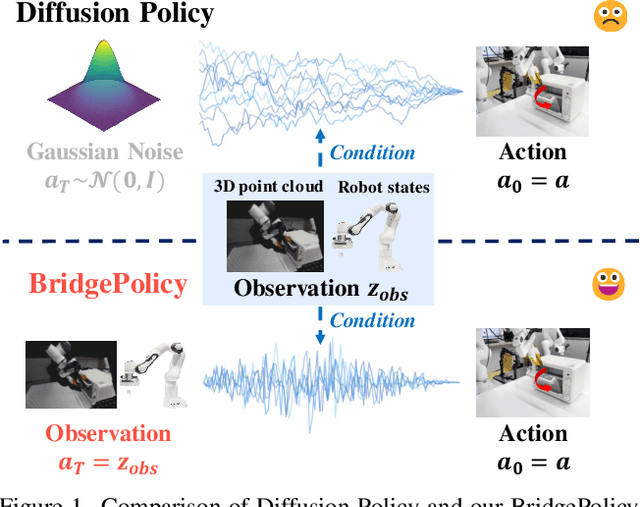
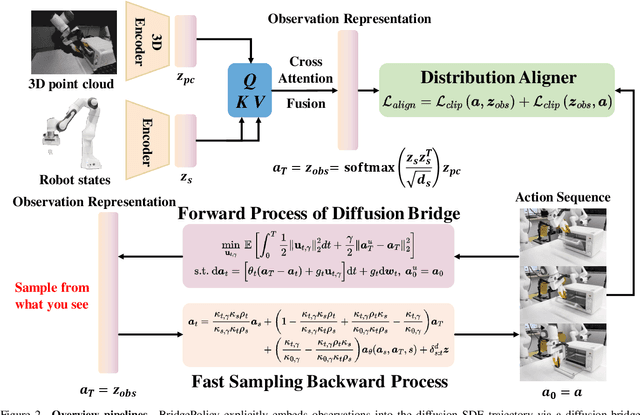
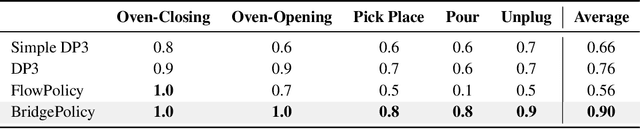
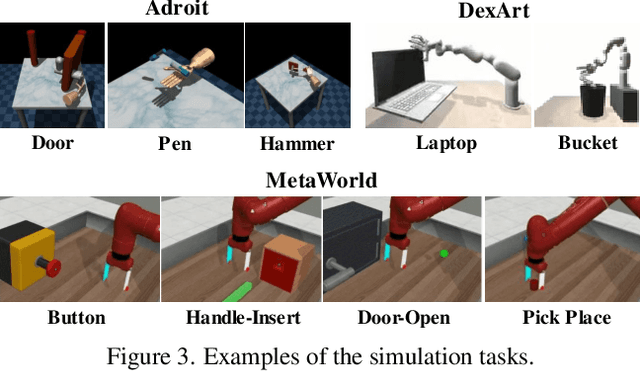
Imitation learning with diffusion models has advanced robotic control by capturing multi-modal action distributions. However, existing approaches typically treat observations as high-level conditioning inputs to the denoising network, rather than integrating them into the stochastic dynamics of the diffusion process itself. As a result, sampling must begin from random Gaussian noise, weakening the coupling between perception and control and often yielding suboptimal performance. We introduce BridgePolicy, a generative visuomotor policy that explicitly embeds observations within the stochastic differential equation via a diffusion-bridge formulation. By constructing an observation-informed trajectory, BridgePolicy enables sampling to start from a rich, informative prior rather than random noise, substantially improving precision and reliability in control. A key challenge is that classical diffusion bridges connect distributions with matched dimensionality, whereas robotic observations are heterogeneous and multi-modal and do not naturally align with the action space. To address this, we design a multi-modal fusion module and a semantic aligner that unify visual and state inputs and align observation and action representations, making the bridge applicable to heterogeneous robot data. Extensive experiments across 52 simulation tasks on three benchmarks and five real-world tasks demonstrate that BridgePolicy consistently outperforms state-of-the-art generative policies.
One-Step Generative Policies with Q-Learning: A Reformulation of MeanFlow
Nov 17, 2025We introduce a one-step generative policy for offline reinforcement learning that maps noise directly to actions via a residual reformulation of MeanFlow, making it compatible with Q-learning. While one-step Gaussian policies enable fast inference, they struggle to capture complex, multimodal action distributions. Existing flow-based methods improve expressivity but typically rely on distillation and two-stage training when trained with Q-learning. To overcome these limitations, we propose to reformulate MeanFlow to enable direct noise-to-action generation by integrating the velocity field and noise-to-action transformation into a single policy network-eliminating the need for separate velocity estimation. We explore several reformulation variants and identify an effective residual formulation that supports expressive and stable policy learning. Our method offers three key advantages: 1) efficient one-step noise-to-action generation, 2) expressive modelling of multimodal action distributions, and 3) efficient and stable policy learning via Q-learning in a single-stage training setup. Extensive experiments on 73 tasks across the OGBench and D4RL benchmarks demonstrate that our method achieves strong performance in both offline and offline-to-online reinforcement learning settings. Code is available at https://github.com/HiccupRL/MeanFlowQL.
OpenHOI: Open-World Hand-Object Interaction Synthesis with Multimodal Large Language Model
May 25, 2025Understanding and synthesizing realistic 3D hand-object interactions (HOI) is critical for applications ranging from immersive AR/VR to dexterous robotics. Existing methods struggle with generalization, performing well on closed-set objects and predefined tasks but failing to handle unseen objects or open-vocabulary instructions. We introduce OpenHOI, the first framework for open-world HOI synthesis, capable of generating long-horizon manipulation sequences for novel objects guided by free-form language commands. Our approach integrates a 3D Multimodal Large Language Model (MLLM) fine-tuned for joint affordance grounding and semantic task decomposition, enabling precise localization of interaction regions (e.g., handles, buttons) and breakdown of complex instructions (e.g., "Find a water bottle and take a sip") into executable sub-tasks. To synthesize physically plausible interactions, we propose an affordance-driven diffusion model paired with a training-free physics refinement stage that minimizes penetration and optimizes affordance alignment. Evaluations across diverse scenarios demonstrate OpenHOI's superiority over state-of-the-art methods in generalizing to novel object categories, multi-stage tasks, and complex language instructions. Our project page at \href{https://openhoi.github.io}
One Policy but Many Worlds: A Scalable Unified Policy for Versatile Humanoid Locomotion
May 24, 2025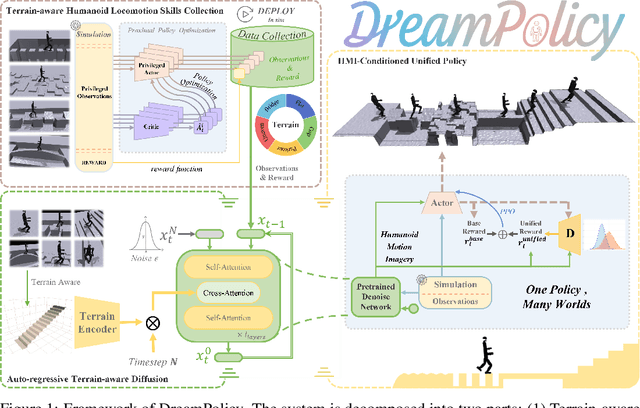
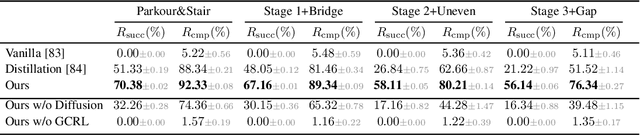
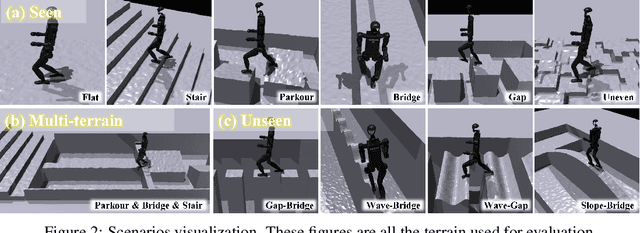
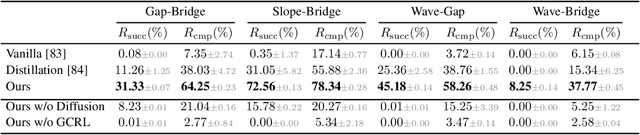
Humanoid locomotion faces a critical scalability challenge: traditional reinforcement learning (RL) methods require task-specific rewards and struggle to leverage growing datasets, even as more training terrains are introduced. We propose DreamPolicy, a unified framework that enables a single policy to master diverse terrains and generalize zero-shot to unseen scenarios by systematically integrating offline data and diffusion-driven motion synthesis. At its core, DreamPolicy introduces Humanoid Motion Imagery (HMI) - future state predictions synthesized through an autoregressive terrain-aware diffusion planner curated by aggregating rollouts from specialized policies across various distinct terrains. Unlike human motion datasets requiring laborious retargeting, our data directly captures humanoid kinematics, enabling the diffusion planner to synthesize "dreamed" trajectories that encode terrain-specific physical constraints. These trajectories act as dynamic objectives for our HMI-conditioned policy, bypassing manual reward engineering and enabling cross-terrain generalization. DreamPolicy addresses the scalability limitations of prior methods: while traditional RL fails to exploit growing datasets, our framework scales seamlessly with more offline data. As the dataset expands, the diffusion prior learns richer locomotion skills, which the policy leverages to master new terrains without retraining. Experiments demonstrate that DreamPolicy achieves average 90% success rates in training environments and an average of 20% higher success on unseen terrains than the prevalent method. It also generalizes to perturbed and composite scenarios where prior approaches collapse. By unifying offline data, diffusion-based trajectory synthesis, and policy optimization, DreamPolicy overcomes the "one task, one policy" bottleneck, establishing a paradigm for scalable, data-driven humanoid control.